Best Practices for Tracking Competitor Landing Pages
SiteChangeTracker Team
Website Monitoring Experts
Why Landing Pages Matter
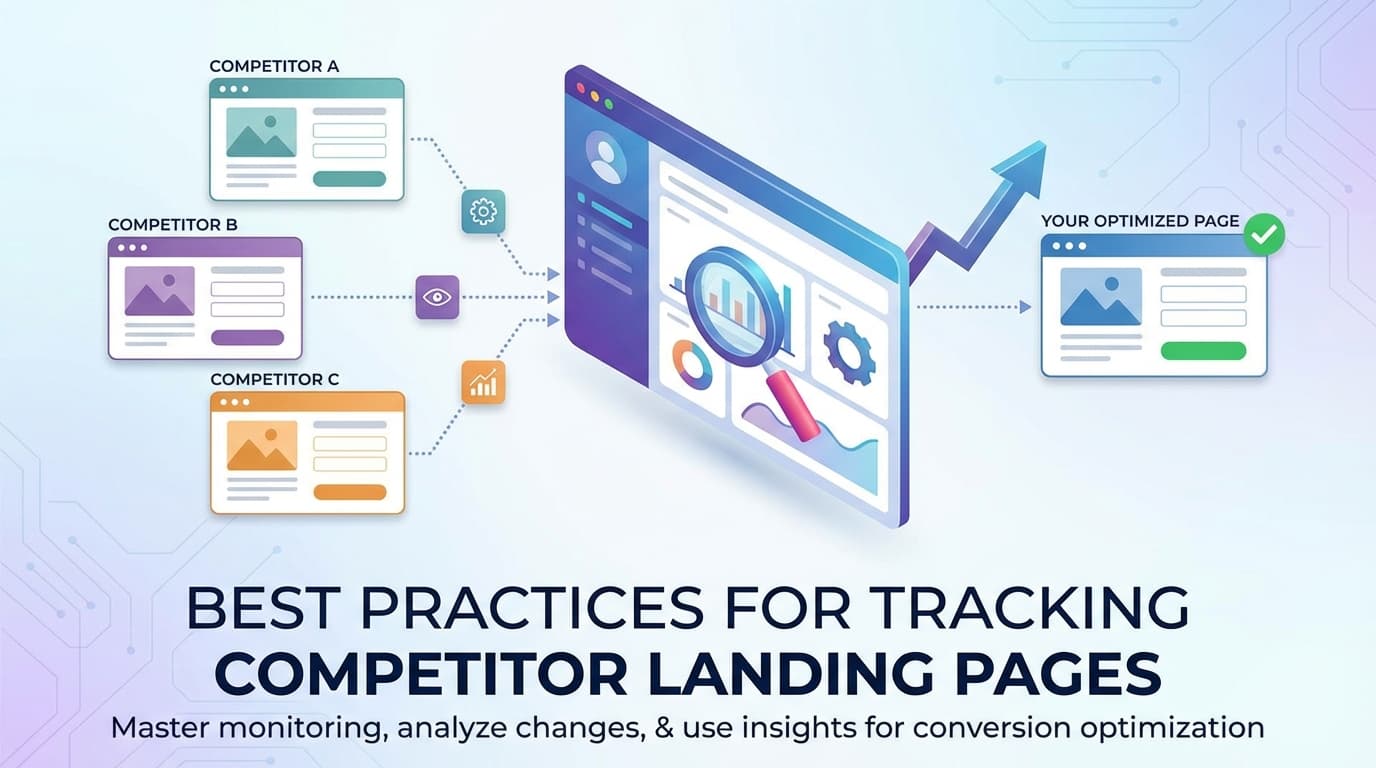
Landing pages are where marketing meets conversion. They represent a company's best effort to turn visitors into customers, leads, or users. Every element—headline, imagery, social proof, call-to-action—has been crafted (and likely tested) to maximise performance.
For competitive intelligence, landing pages are gold mines. When competitors change their landing pages, they're essentially sharing the results of their optimisation efforts. A headline change suggests their previous version underperformed. A new social proof element indicates what resonates with their audience.
What to Monitor on Landing Pages
Headlines and Value Propositions
The headline is typically the most tested element on any landing page. Monitor:
- Primary headline text and structure
- Subheadline supporting messages
- Value proposition framing
- Emotional vs rational appeals
Visual Elements
Design choices communicate as much as copy. Track:
- Hero images and product visuals
- Colour schemes and button colours
- Layout and information hierarchy
- Mobile vs desktop presentations
Social Proof
Trust elements evolve as companies grow. Monitor:
- Customer testimonials and quotes
- Logo walls and client lists
- Case study references
- Review scores and ratings
- User counts and metrics
Calls-to-Action
CTAs directly impact conversion. Track:
- Button text and language
- CTA placement and prominence
- Urgency elements
- Secondary CTAs and escape routes
Form Design
Lead capture forms balance information gathering with friction. Monitor:
- Number and type of form fields
- Required vs optional fields
- Form layout and styling
- Progressive disclosure approaches
Pricing and Offers
Commercial elements on landing pages signal strategy. Track:
- Displayed pricing or price ranges
- Promotional offers and discounts
- Free trial or freemium offers
- Money-back guarantees
Setting Up Effective Monitoring
Identify Key Landing Pages
Competitors likely have multiple landing pages. Prioritise:
- Homepage: General positioning and primary CTA
- Product pages: Feature emphasis and differentiation
- Campaign pages: Paid traffic destinations (often found through ad research)
- Feature pages: Specific capability positioning
- Pricing pages: Commercial strategy and packaging
Choose Your Detection Method
Visual monitoring works best for landing pages because:
- Design changes are immediately visible
- A/B test variations are easy to spot
- Screenshot archives provide rich historical data
- Specific copy changes
- Pricing updates
- Technical specifications
Configure Appropriate Settings
Monitor frequency: Landing pages can change frequently during optimisation. Consider daily or twice-daily checks for active competitors.
Change thresholds: Set visual thresholds that catch meaningful changes without alerting on minor variations (loading differences, dynamic content).
Focus areas: Some monitoring tools allow you to specify page regions. Focus on above-the-fold content where most changes occur.
Analysing Landing Page Changes
Document Everything
When you detect a change: 1. Capture the before and after states 2. Note the date and time 3. Document all visible differences 4. Tag the type of change (copy, design, offer, etc.)
Look for Patterns
Over time, patterns emerge:
- How often does this competitor update their pages?
- What elements do they test most frequently?
- When do they typically make changes?
- Do changes correlate with external events?
Interpret Strategically
Ask what the change suggests:
- Copy change: Are they targeting a different audience or pain point?
- Design change: Have they discovered a higher-performing layout?
- Social proof update: What new proof points do they have?
- CTA change: What language drives their conversions?
Form Hypotheses
Use competitor changes to inform your own testing:
- "Competitor X changed their headline from feature-focused to benefit-focused. Should we test this approach?"
- "Multiple competitors now include video testimonials. Is this becoming a market standard?"
- "Competitor Y removed their pricing from the landing page. Are they seeing better results with a consultation approach?"
Applying Intelligence to Your Pages
Inspiration, Not Imitation
Competitor monitoring should inspire hypotheses, not blind copying:
- Adapt concepts to your unique positioning
- Test changes with your own audience
- Validate that what works for them works for you
Build a Testing Backlog
Maintain a prioritised list of test ideas sourced from competitive intelligence:
- High-impact observations (major design changes by market leaders)
- Trend observations (changes multiple competitors are making)
- Counter-position opportunities (things competitors avoid that might work for you)
Accelerate Your Learning
Competitive monitoring accelerates your optimisation:
- Skip tests competitors have already run (and abandoned)
- Prioritise approaches multiple competitors adopt
- Learn from market leaders' iterations
Advanced Strategies
Track Campaign Landing Pages
Find competitor paid campaign landing pages through:
- Clicking their ads (Google, Facebook, LinkedIn)
- Ad intelligence tools
- Industry landing page galleries
Monitor Multiple Variants
Sophisticated competitors run multiple landing page variants simultaneously. If you notice inconsistent pages, you may be seeing their A/B tests in progress.
Correlate with Other Intelligence
Connect landing page changes to broader competitive signals:
- Do homepage changes align with blog announcements?
- Do landing pages shift before product launches?
- Do seasonal landing pages follow predictable patterns?
Common Monitoring Mistakes
Monitoring Too Many Pages
Focus drives insight. Monitor the pages that matter most rather than every page you can find.
Ignoring Context
A landing page change means nothing without context. Why might they have made this change? What were they testing against?
Copying Without Testing
Even if a competitor's approach seems successful, test it with your audience before committing.
Neglecting Your Own Data
Competitive intelligence supplements—never replaces—your own conversion data and testing.
Getting Started
Launch your landing page monitoring programme:
1. Identify your top three competitors' key landing pages 2. Set up visual monitoring with appropriate thresholds 3. Create a simple tracking document for changes 4. Review detected changes weekly 5. Translate observations into testing hypotheses 6. Gradually expand your monitoring scope
Systematic landing page monitoring provides ongoing insights into competitor conversion strategies—intelligence that can accelerate your own optimisation efforts.

Ready to Monitor Your Competitors?
Start tracking competitor websites today with SiteChangeTracker. Get instant alerts when prices change, features launch, or content updates—all automatically.
No credit card required • Cancel anytime