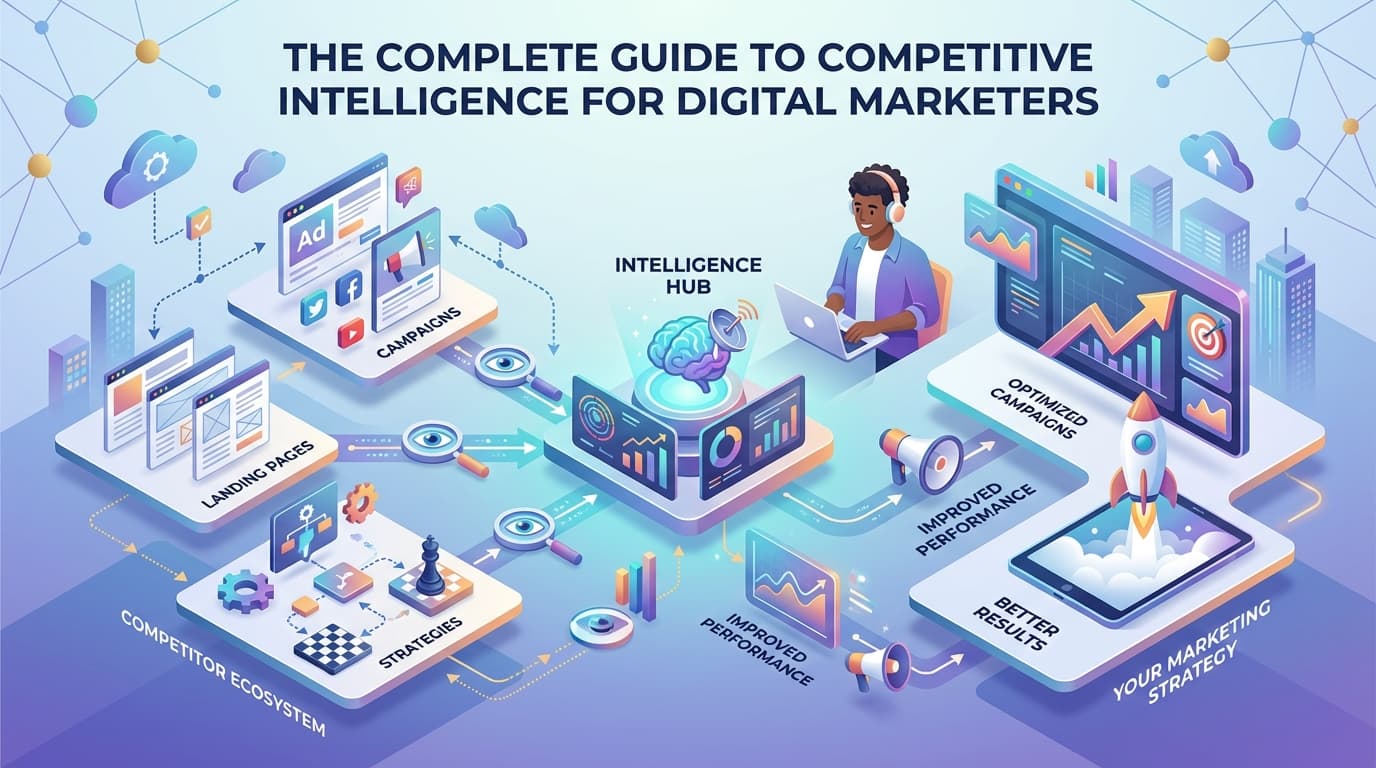
The Complete Guide to Competitive Intelligence for Digital Marketers
SiteChangeTracker Team
Website Monitoring Experts
Understanding Competitive Intelligence in Digital Marketing
Competitive intelligence (CI) is the systematic collection and analysis of information about competitors to inform strategic decisions. For digital marketers, this means understanding how rivals position themselves, what messages they use, and how they evolve their strategies over time.
Unlike industrial espionage or unethical practices, competitive intelligence relies entirely on publicly available information. Every change a competitor makes to their website, landing pages, or public marketing materials is fair game for analysis.
Why Digital Marketers Need Competitive Intelligence
Stay Ahead of Market Trends
Competitors often signal market shifts through their marketing changes. A competitor pivoting their messaging might indicate changing customer preferences you should consider. New landing page variants suggest they're testing hypotheses you might benefit from.
Improve Campaign Performance
Understanding what works for competitors—and what doesn't—accelerates your own learning. Rather than starting from scratch with every campaign, build on collective market knowledge.
Identify Differentiation Opportunities
Thorough competitive analysis reveals gaps in the market. When you understand what everyone else is saying, you can craft unique positioning that stands out.
Validate Your Strategy
Competitive intelligence provides context for your own decisions. Are your conversion rates competitive? Is your messaging aligned with market expectations? CI answers these questions.
Key Areas to Monitor
Landing Pages and Conversion Paths
Landing pages represent competitors' best conversion efforts. Monitor:
- Headline variations: What messages do they test?
- Value propositions: How do they communicate benefits?
- Social proof: What testimonials and trust signals do they use?
- Call-to-action copy: What language drives their conversions?
- Form length and fields: How much information do they request?
- Visual design: What imagery and layouts do they favour?
Website Content and Messaging
Beyond landing pages, track broader website changes:
- Homepage messaging and hero sections
- Product or service descriptions
- About and team pages
- Blog content and publishing frequency
- Case studies and success stories
Pricing and Offer Structure
Understand how competitors structure their offerings:
- Pricing tiers and feature comparisons
- Free trial or freemium offerings
- Promotional discounts and special offers
- Money-back guarantees and risk reversals
Email Marketing (Where Visible)
Subscribe to competitor email lists to track:
- Onboarding sequences
- Promotional campaigns
- Content marketing approaches
- Send frequency and timing
Building Your Competitive Intelligence System
Step 1: Define Your Competitive Set
Not all competitors deserve equal attention. Categorise them:
Primary competitors: Direct rivals targeting the same audience with similar offerings. Monitor these most intensively.
Secondary competitors: Indirect competitors or those in adjacent markets. Track periodically for emerging threats or opportunities.
Aspirational competitors: Market leaders you want to learn from, even if you're not directly competing today.
Step 2: Determine What to Track
Create a monitoring framework covering:
- Specific pages to watch (landing pages, pricing, homepage)
- Types of changes that matter (copy, design, offers)
- Frequency of checks required
- Team members responsible for analysis
Step 3: Implement Monitoring Tools
Manual monitoring doesn't scale. Implement automated solutions that:
- Detect changes on specified pages
- Capture visual screenshots for comparison
- Alert relevant team members
- Archive historical versions
Step 4: Establish Analysis Processes
Data without analysis is just noise. Create regular review processes:
- Weekly quick reviews of significant changes
- Monthly deep-dives into competitor strategies
- Quarterly strategic assessments of competitive landscape
Translating Intelligence into Action
A/B Testing Inspiration
Competitor changes suggest hypotheses to test:
- If a competitor changes their headline, test a similar approach
- When multiple competitors adopt a design pattern, consider whether it works for you
- Competitor pricing changes might indicate optimal price points to test
Content Gap Analysis
Track competitor content to identify opportunities:
- Topics they cover that you haven't addressed
- Content formats that seem successful
- Keywords they're targeting
Messaging Refinement
Use competitive messaging to sharpen your own:
- Find unique angles others haven't claimed
- Identify overused phrases to avoid
- Understand market expectations to meet or exceed
Strategic Positioning
Comprehensive competitive intelligence informs positioning:
- Where can you credibly differentiate?
- What claims can you uniquely make?
- How should you price relative to alternatives?
Common Competitive Intelligence Mistakes
Analysis Paralysis
Don't let competitive monitoring become an excuse for inaction. The goal is informed decision-making, not perfect information.
Copycat Syndrome
Intelligence should inspire, not dictate. Blindly copying competitors means you'll always be following, never leading.
Confirmation Bias
Don't only notice changes that confirm your existing beliefs. Look for evidence that challenges your assumptions.
Ignoring Small Players
Innovative disruption often comes from unknown competitors. Don't focus exclusively on established players.
Tools and Technologies
Website Monitoring Solutions
Modern website change detection tools automatically track competitor pages and alert you to changes. Look for features like:
- Visual change detection for design modifications
- Text-based monitoring for copy changes
- Flexible alert configurations
- Historical archives for trend analysis
Analytics and Research Tools
Complement direct monitoring with:
- SEO tools for keyword and backlink analysis
- Social listening for brand mentions
- Ad intelligence for paid campaign tracking
Measuring CI Effectiveness
Track whether your competitive intelligence efforts pay off:
- Decision speed: Are you making informed decisions faster?
- Campaign performance: Do CI-informed campaigns outperform?
- Market position: Is your competitive standing improving?
- Team efficiency: Is less time spent on manual research?
Getting Started
Begin with a focused approach:
1. Identify your three most important competitors 2. Select five key pages to monitor for each 3. Set up automated monitoring with meaningful alerts 4. Establish a weekly review rhythm 5. Gradually expand scope as you develop expertise
Competitive intelligence is a journey, not a destination. Start simple, learn continuously, and evolve your approach as your needs grow.
Ready to Monitor Your Competitors?
Start tracking competitor websites today with SiteChangeTracker. Get instant alerts when prices change, features launch, or content updates—all automatically.
No credit card required • Cancel anytime