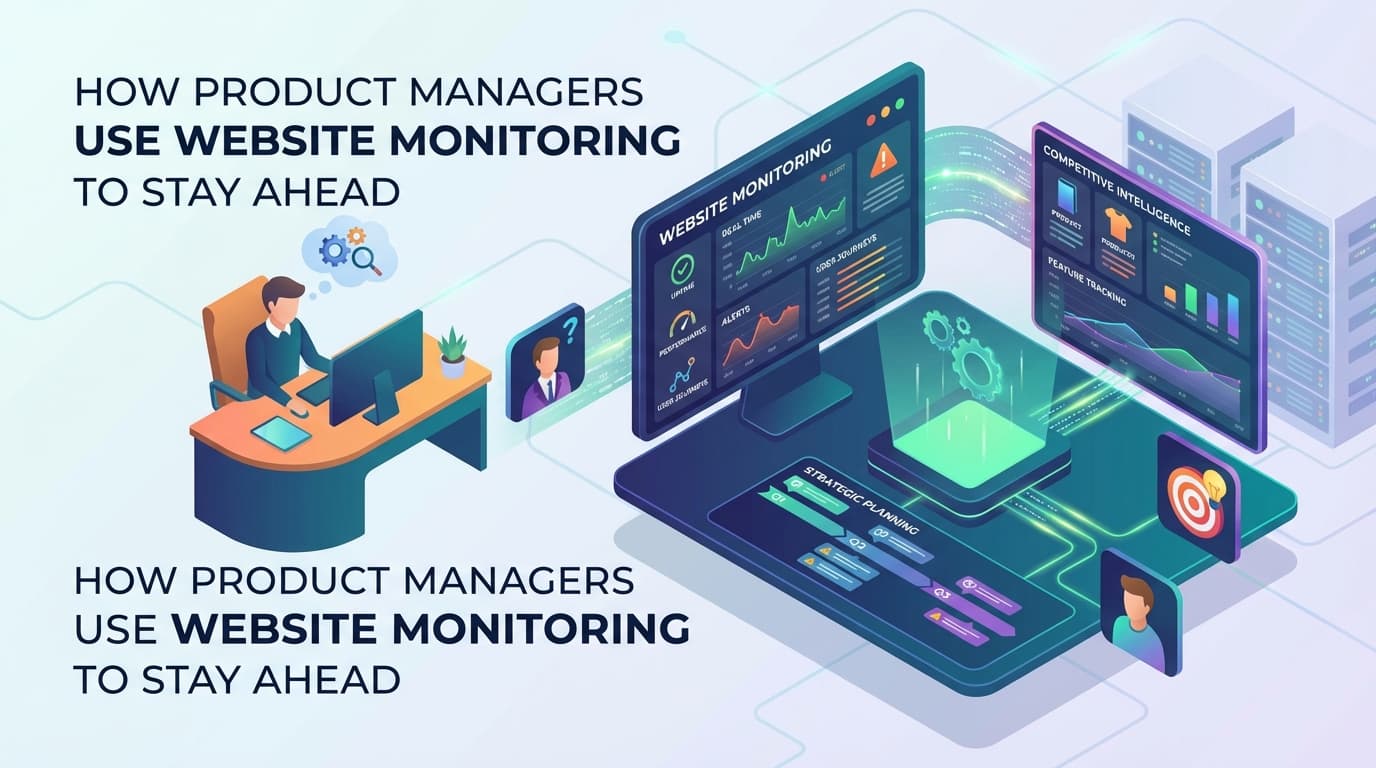
How Product Managers Use Website Monitoring to Stay Ahead
SiteChangeTracker Team
Website Monitoring Experts
The Product Manager's Intelligence Challenge
Product managers operate at the intersection of customer needs, business goals, and competitive reality. Making sound product decisions requires understanding not just what customers want, but what alternatives exist in the market.
Traditional competitive analysis—quarterly reports, trade publications, occasional website visits—fails to capture the dynamic nature of modern product development. Competitors release features, adjust positioning, and modify pricing continuously. By the time these changes appear in formal reports, the information is already outdated.
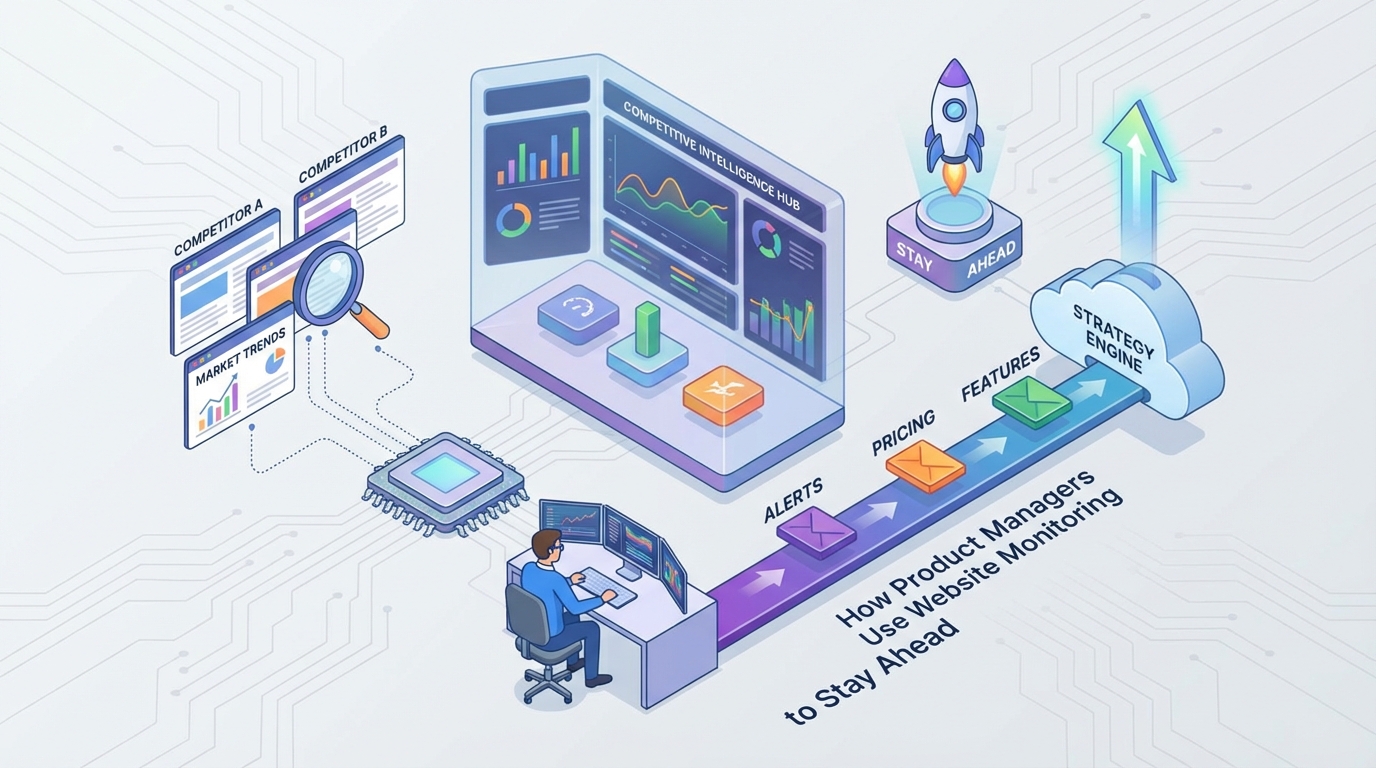
Website monitoring bridges this gap, providing real-time intelligence on competitor product evolution.
Key Use Cases for Product Managers
Feature Launch Detection
When competitors release new features, the evidence appears on their websites: new landing pages, updated feature lists, modified screenshots, and revised documentation. Automated monitoring detects these changes immediately.
What to monitor:
- Product feature pages and comparison tables
- Documentation and help centres
- Changelog or "What's New" pages
- Marketing pages highlighting capabilities
- Assess competitive response requirements
- Inform your own roadmap prioritisation
- Identify market direction and emerging standards
- Brief stakeholders on market evolution
Pricing and Packaging Changes
Competitor pricing adjustments signal strategic shifts. A price reduction might indicate market pressure; a new tier suggests segment targeting; removed features hint at product simplification.
What to monitor:
- Pricing pages and tier structures
- Feature comparison matrices
- Terms and conditions
- Free trial and freemium offerings
- Validate or adjust your pricing strategy
- Understand value perception in the market
- Identify opportunities for differentiation
- Plan responses to aggressive pricing moves
Positioning and Messaging Evolution
How competitors describe themselves reveals their strategic priorities. Messaging changes often precede product changes, signalling future direction.
What to monitor:
- Homepage headlines and value propositions
- "About" pages and company descriptions
- Target audience indicators
- Competitive comparison pages
- Refine your own positioning
- Anticipate competitive moves
- Identify messaging gaps to exploit
- Understand evolving market narratives
Integration and Partnership Announcements
Integration pages reveal competitor platform strategies and partnership priorities. New integrations suggest target market expansion or technical evolution.
What to monitor:
- Integration directories and marketplace pages
- Partner announcement pages
- API documentation changes
- App store listings
- Inform partnership strategy
- Identify integration opportunities
- Understand technical platform trends
- Assess ecosystem competition
Building Your Monitoring Framework
Prioritise Your Competitive Set
Not all competitors deserve equal attention. Categorise by strategic importance:
Tier 1 - Direct competitors: Monitor comprehensively, including product pages, pricing, documentation, and marketing.
Tier 2 - Adjacent competitors: Monitor key pages for significant changes.
Tier 3 - Aspirational/emerging: Periodic monitoring for trend awareness.
Define Your Monitoring Map
For each Tier 1 competitor, identify specific pages to track:
| Page Type | Example URL | Monitor Frequency | Change Significance |
|---|---|---|---|
| Homepage | /home | Daily | Positioning shifts |
| Features | /features | Daily | New capabilities |
| Pricing | /pricing | Daily | Commercial changes |
| Docs | /docs | Weekly | Product depth |
| Integrations | /integrations | Weekly | Ecosystem play |
| Blog | /blog | Weekly | Strategic signals |
Configure Meaningful Alerts
Avoid alert fatigue by configuring smart notifications:
- Immediate alerts: Pricing changes, new feature announcements
- Daily digest: Homepage updates, positioning changes
- Weekly summary: Documentation updates, blog content
Establish Analysis Rhythms
Intelligence without analysis is just noise. Build regular review cycles:
Weekly: Quick scan of significant changes across Tier 1 competitors Monthly: Deep-dive into one competitor's evolution Quarterly: Comprehensive landscape assessment
Translating Intelligence into Product Decisions
Roadmap Influence
Competitive intelligence should inform, not dictate, your roadmap:
- Validate priorities: Does competitor activity confirm your strategic bets?
- Identify gaps: What are competitors offering that you're not?
- Question assumptions: Does market behaviour match your hypotheses?
- Spot opportunities: Where are competitors weak or absent?
Stakeholder Communication
Use competitive intelligence to enhance stakeholder discussions:
- Share relevant changes in product reviews
- Contextualise your roadmap with market reality
- Proactively address competitive concerns
- Build credibility through market awareness
Win/Loss Analysis Enhancement
Combine competitive intelligence with sales feedback:
- Correlate feature launches with win rate changes
- Understand competitor strengths mentioned in losses
- Identify emerging competitive threats early
- Validate competitive positioning in the field
Common Pitfalls to Avoid
Reactive Feature Development
Don't let every competitor feature trigger a development sprint. Evaluate changes against your strategy and customer needs.
Analysis Without Action
Intelligence is valuable only when it influences decisions. Ensure your monitoring programme connects to decision-making processes.
Overcomplicating Your Setup
Start simple with a few key pages for top competitors. Expand based on what proves valuable.
Ignoring Second-Order Effects
Consider why competitors make changes, not just what changed. A pricing reduction might signal market pressure or a strategic shift worth deeper analysis.
Getting Started
Begin your product management monitoring programme with these steps:
1. List your top three direct competitors 2. Identify five key pages for each (homepage, features, pricing, docs, blog) 3. Set up automated monitoring with appropriate alert thresholds 4. Block 30 minutes weekly to review changes and implications 5. Share relevant insights in your next product review
Website monitoring transforms competitive intelligence from a periodic project into continuous market awareness. For product managers navigating competitive markets, this real-time intelligence is increasingly essential.
Ready to Monitor Your Competitors?
Start tracking competitor websites today with SiteChangeTracker. Get instant alerts when prices change, features launch, or content updates—all automatically.
No credit card required • Cancel anytime